
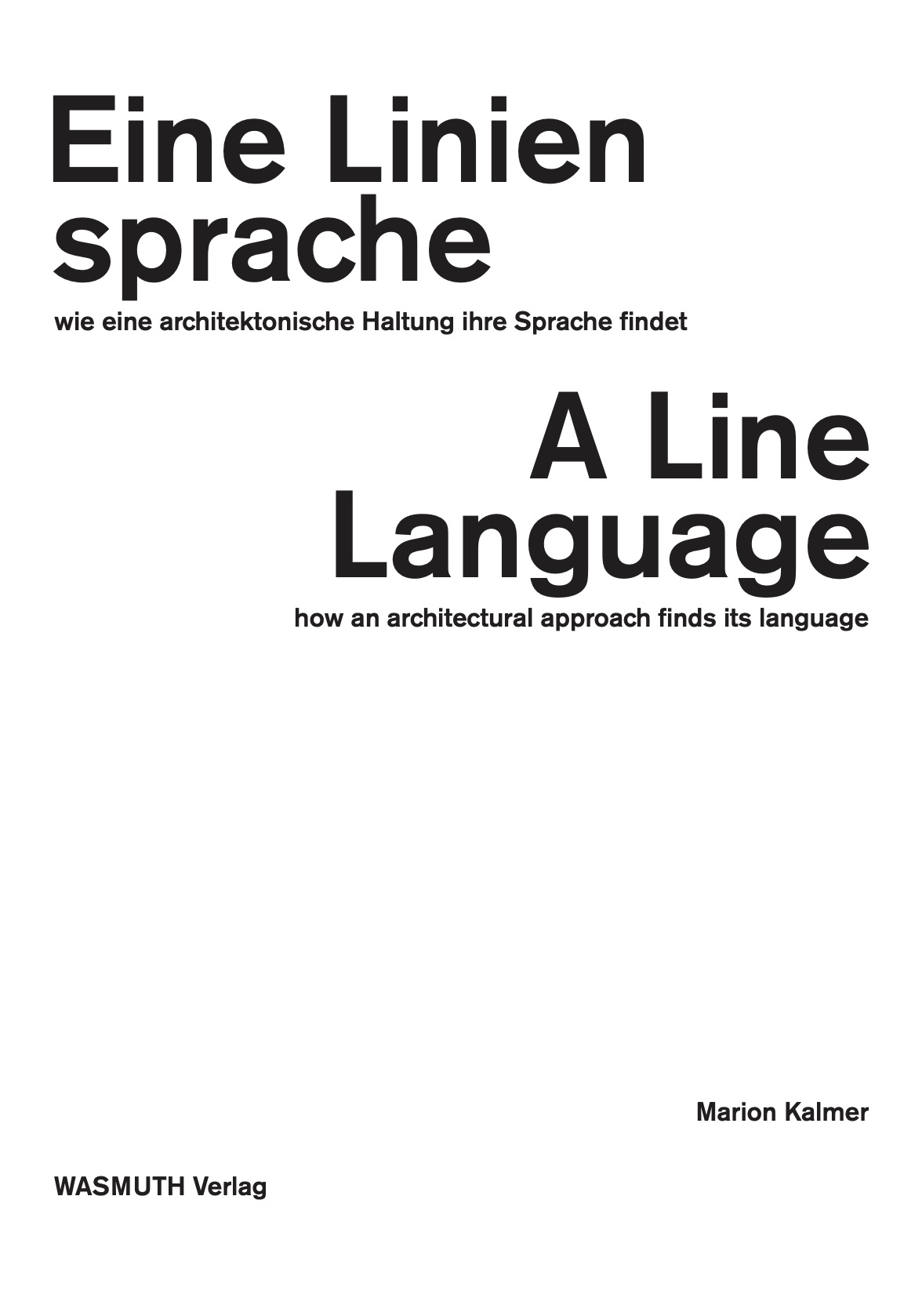
A Line Language
How an architectural approach finds its language - the translations
A Language of Lines explores architectural drawing as a space for thought, research, and negotiation, rather than merely a means of representation. Through conversations with internationally renowned architects and a selection of their work, it presents the diversity of contemporary analogue, digital, and hybrid drawing practices. An inspiring compendium of distinctive positions, methods, and visual languages for everyone seeking to rethink complex spatial questions. To view and download the English translation of the interviews, conducted in German, click on "Leseprobe" on top of this page.
- Herausgeber: Marion Kalmer
- ISBN: 978 3 8030 3441 0
- Format: 148 x 210 mm
- Auflage: 1. Auflage
€38,00
inkl. 7 % MwSt.
Nicht vorrätig
-
A Line Language presents architectural drawing as far more than a tool of representation: as a site of thought, research, and negotiation. At its centre are “drawn narratives” – precise, scaled drawings that translate spatial, social, political, and ecological questions into distinct visual languages.
Drawing on conversations with internationally renowned architects who have developed original graphic modes of expression for their individual architectural positions, alongside a selection of their work, the book unfolds a multifaceted panorama of contemporary drawing practice. Analogue, digital, and hybrid techniques meet beyond familiar oppositions: from the hand-drawn line to the experimental use of digital tools.
A Language of Lines understands drawing as a cultural practice and as an intellectual and sensory medium of architectural production. An inspiring compendium of exceptional positions, methods, and references – for architectural education and practice alike, and for all those seeking to rethink complex spatial questions. The book originated in a fascination with the surprising poetry and extraordinary diversity of architectural drawing languages as they are currently being brought forth by the discipline.
Conversation were held with
- amid.cero9 (cero9.com)
- AMUNT (amunt.info)
- Angela Deuber (angeladeuber.com)
- architecten jan de vylder inge vinck (architectenjdviv.com)
- BairBalliet (bairballiet.com)
- Barozzi Veiga (barozziveiga.com)
- Endemic Architecture (endemicarchitecture.com)
- fala (falaatelier.com)
- KOSMOS (k-s-m-s.com)
- Max Otto Zitzelsberger (maxottozitzelsberger.de)
- MOS (mos.nyc)
- nbundm* (nbundm.de)
- OFICINAA (oficinaa.net)
- Pedro Pitarch (pedropitarch.com)
- Perry Kulper (instagram.com/pkulper/)
- Raphael Zuber (raphaelzuber.com)
- Smout Allen (smoutallen.com)
- Alexander Tochtermann (alexandertochtermann.com) + Philipp Wündrich (philippwuendrich.com)
-
Herausgeber Marion Kalmer ISBN 978 3 8030 3441 0 Auflage 1. Auflage Format 148 x 210 mm Seitenanzahl 328 Erscheinungsdatum 2. Oktober 2026 Sprachen deutsch, englisch Abbildungen über 160 meist farbige Abbildungen -
Marion Kalmer (Prof. Dr.-Ing.), born in 1972, has been teaching at the Faculty of Architecture at Technische Hochschule Nürnberg since 2016. In addition, she runs the office Studio Supernova in Zurich. Her academic research investigates aesthetic issues within a broader conception of the architectural discipline. After holding several academic teaching positions, including one at the Swiss Federal Institute of Technology in Zurich, she earned her doctorate from the University of Stuttgart in 2019. Her dissertation The New (Real-Time) Order of Cities: How Digital Applications Re-organise Urban Space was published in 2021. With the aim of rethinking existing structures, revealing unexpected spatial qualities, and articulating the traces of time, her practice is primarily concerned with existing built fabric.
Verwandte Produkte


Weitere Empfehlungen